Chris Salter
Performance & Installations
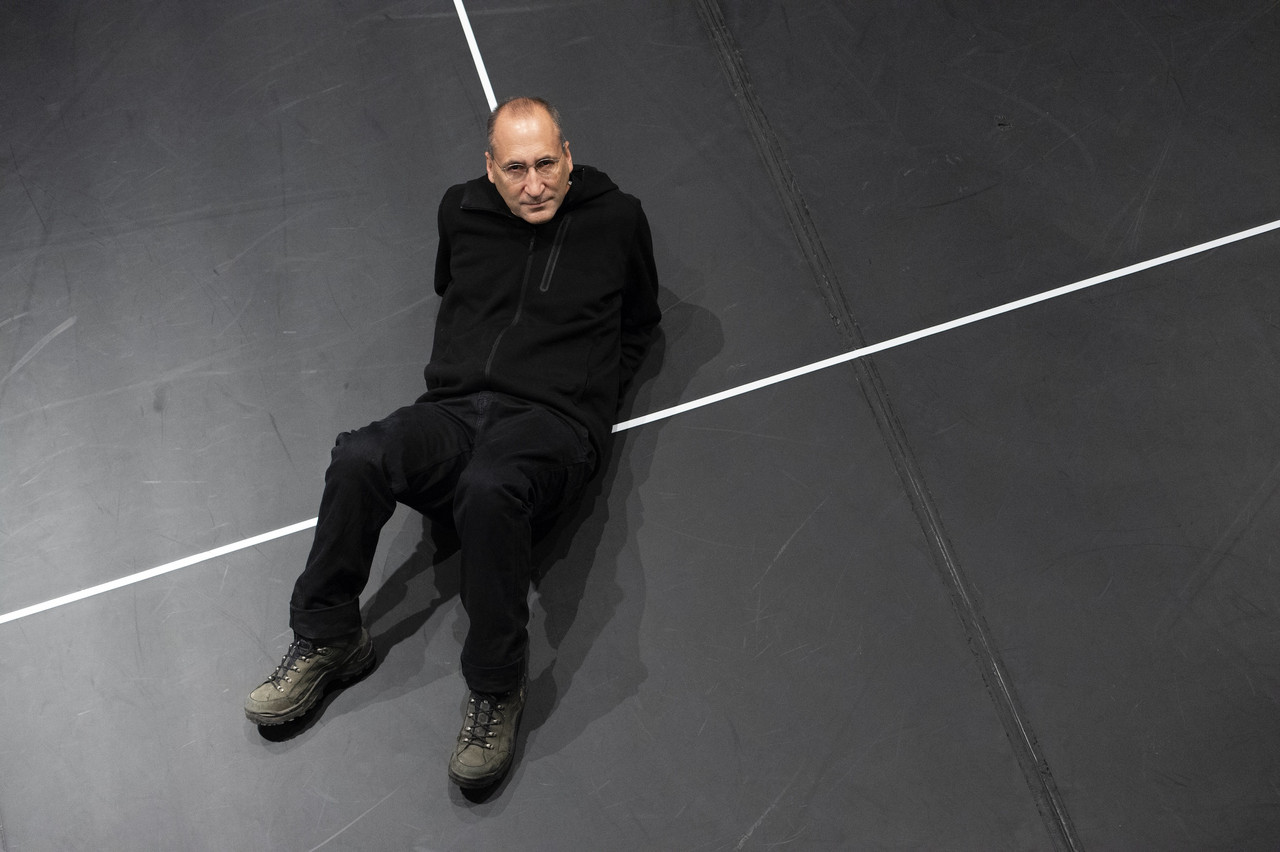
Territory: Worldwide
Salter’s work has been shown at major international exhibitions and festivals in over a dozen countries including the 2008 Venice Architecture Biennale (Venice), National Art Museum of China (Beijing), Lille 3000 (Lille), Fondarie Darling (International Biennale of Electronics Arts – Montreal), HAU3 (Berlin), Laboral Centro de Arte y Creacion Industriel (Gijon, Spain), Nuit Blanche (Paris), Vitra Design Museum (Germany), EXIT Festival (Maison des Arts, Creteil-Paris), Ars Electronica (Linz), Pact Zollverein (Essen, Germany), CTM (Berlin), Villette Numerique (Paris), TodaysArt (the Hague), TodaysArt.jp (Tokyo), Meta.Morf (Norway), Mois Multi (Quebec), transmediale (Berlin), Elektra (Montréal), the Banff Center (Banff), Dance Theater Workshop (New York), V2 (Rotterdam), SIGGRAPH 2001 (New Orleans), Mediaterra (Athens) and the Exploratorium (San Francisco).
Salter was Concordia University Research Chair in New Media, Technology and the Senses, Co-Director of the Hexagram Network for Research-Creation in Media Art, Design, Digital Culture and Technology, Director of Hexagram Concordia and Associate Professor, Computation Arts in the Department of Design and Computation Art at Concordia University, Montreal. He is a regular presenter at national and international conferences, has given numerous invited talks at universities and festivals worldwide and has sat on many juries including the Prix Ars Electronica among others.
In addition to his artistic work, Salter’s critical research can be found in his seminal book, Entangled: Technology and the Transformation of Performance (MIT Press, 2010) and Alien Agency: Experimental Encounters with Art in the Making (MIT Press, 2015).
ZANGEZI is a contemporary staging and reinterpretation of Russian Futurist Velimir Khlebnikov's visionary, planetary sound-based dramatic poem from 1922. The production explores central questions of our time: the tension between humans and nature, the power of language, and war and conflict as drivers of historical change. Involving an international team of renowned creators from the fields of music, visual arts, AI, performance, and technology, a spectacular live media performance unfolds.
Written after the violent upheavals of World War I, the Russian civil war and the Russian Revolution, Zangezi explores language as sound: songs, noises, onomatopoeic sounds (such as birdsong), poetic monologues and dialogues between Zangezi, human and prophet, and the natural and divine world.
In our new performance, we transport Zangezi into the current climatological, political and technological state of the planet: a world in which we strive to make sense of that which makes no sense. In this way, Zangezi powerfully resonates between the Russian Futurist moment 104 years ago and our unstable present and future.
Website ZANGEZI
SET UP & HARDWARE
CAPTURING STATION
- 65" TV, portrait mode (Full HD min., 4K preferred)
- Computer - Mac Studio Pro
- Astera light panels • ArtNET DMX node
- Infrared camera + tripod
- Scarlett 2i2 audio interface • Internet (LAN/WiFi)
PROJECTION
- 4K UHD - 3840 × 2160 px resolution
Stereo speakers with subwoofer, or multi-speaker
ARTIST CREDITS
Chris Salter - Project Lead
Florian Bruggisser - Volumetric Capturing • Machine Learning
Chris Elvis Leisi - Experience Animation
Pascal Lund-Jensen - Sound Design
Kristina Jungic - Production
Immersive Arts Space - ZHdK
PAST EXHIBITIONS
Swissnex - San Francisco
Refresh Festival - Zurich
MALI, Museo de Arte de Lima - Lima
KIKK Festival - Namur
MEET | Digital Culture Center - Milan
Grand Palais Immersif - Paris
Teatros del Canal - Madrid
Ars Electronica - Linz
Digital Arts Zurich (DA-Z)
Zurich Art Weekend
Text by Kate Story
Music & Sound by Catarina Barbieri, Limpe Fuchs, Sam Slater, Maxime Gordon
Choreography by Angelique Wilki
Scenography by Florence To
3D Animation by Timothy Thomasson
Daniel and Laurie are two people on the run from a near future world of
climate transformation. Emotionally distraught from their hidden pasts, the
pair set out on a journey through the wild landscape of Newfoundland,
Canada. While news of global climate catastrophes is broadcast on their
car radio, they drive towards the Tablelands, an extraordinary, Mars-like
landscape in the middle of Von Gros Morne National Park where one can
directly walk on the mantle of the Earth. Gradually, the climate-change
transformed landscape exerts a force on them as if it was a conscious,
living and breathing entity. It emits strange sounds, affects Daniel and
Laurie’s physical bodies and their personal relationship and in the dra-
matic conclusion of Animate, manifests the intricate interconnectedness
of humans and a natural world under the throes of radical environmental
change. Die Belebung (Animate) sits at the crossroads of performance,
installation and radio play utilizing the newest Virtual and Augmented Re-
ality technologies in order to blur the experience between the physical
and the digital world. An interdisciplinary international artistic and techno-
logical team from Montreal Canada and Berlin Germany thus takes the
audience on an extraordinary participatory journey that uses the creative
potential of new technologies to address the urgency of climate catastro-
phe.
A Work by Erik Adigard, Sofian Audry, FM Einheit, Dietmar Lupfer, Chris Salter, Alex Schweder and Sissel Tolaas
SENSEFACTORY is a spectacular large scale performative installation
(25 × 13 × 5 meters) combining architecture, sound, smell, light and
AI technology into a immersive multi-sensorial experience. In the
1920s, László Moholy-Nagy with the Bauhaus imagined a new kind of a
theater for the senses. In a “Mechanized Eccentric” as he called it
machine and organism should be merged. 100 years later this utopian
vision now can be experienced in an up-to-date version that uses latest
technological developments. Created by an international team of artists,
architects, designers and technologists, SENSEFACTORY sends visitors on
an exhilarating sensory journey through a colossal, ever transforming
pneumatic architectural environment that changes form and shape before
your very eyes.
The Bauhaus sought a new relationship between humans and machines – a
theater that would integrate the human spectator and actor into a new kind
of rhythmic and dynamic media process. 100 years later, we are enveloped
in these total environments of media that continually scan, surveil,
record, monitor and transform us. SENSEFACTORY reflects on our radical
times – creating a compelling event that oscillates between intensive
sensual experience and meditative reflection; physical euphoria and
nervous unease.
Concept: Chris Salter + TeZ + JNBY China
Direction/Composition: Chris Salter + TeZ in collaboration with Ian Hattwick
Clothing Design: JNBY
Technical Development: IDMIL, Director: Marcelo Wanderley, McGill University
Technical Direction: Ian Hattwick
Additional Technical Support: Julian Neri
Production: xmodal/Montreal + CAC
Haptic Field is a participatory multi-sensory installation merging contemporary fashion, wearable technology and an exploration of the senses beyond site that creates a singular and uncanny physical experience for the public. In the environment, a group of up to twenty visitors wear specially designed garments, which are outfitted with various sensing and actuating devices that enable visitors to interface with the performance space. Haptic Field thus provokes unusual and intense bodily sensations by blurring our senses of touch, sight and sound. With one’s ability to visually navigate and make sense of the world removed upon entering the installation, the visitor enters a continually shifting, hallucinatory, almost dream-like environment where nothing is what it seems and where one begins to experience other senses like touch, sound, proprioception, the experience of time and the invisible presence of others —senses that we normally ignore or forget about in our mainly visually dominated world.
Haptic Field forms part of a continued artistic exploration into the extension of the human sensorium within our contemporary technosphere. Beginning with JND (2010), continuing with Displace (2011-2013) and most recently, Ilinx (2014-2015), both collaborations with the Italian-born, Amsterdam based artist and musician TeZ, these sensory installations have been exhibited world-wide and examine how the boundaries between our different senses are, in fact, culturally constructed and how new technologies work to increasingly extend, shape and transform our sensorial experience within our socio-technical environment.
Supported by the Fonds de Recherche du Quebec - Societe et Culture and the Canada Arts Council.


