Guy Ben-Ary & Nathan Thompson
Installations & Live Performance
Territory: Worldwide
By Guy Ben-Ary, Nathan Thompson, Stuart Hodgetts, Matt Gingold in collaboration with Alvin Lucier
Video Revivification
What happens to the artists’ creativity once they have passed away?
Can the essence of a performer be retained if the person is no longer physically present?
Situated within debates around human agency and the impact of generative AI, Revivification is an attempt to immortalise the late experimental composer Alvin Lucier (1931-2021). The project gives him new life by creating a biological 'surrogate performer' – a living autonomous entity that keeps on creating, long after his death.
Lucier was a sound art pioneer whose approach to composition profoundly altered contemporary music as he emphasised the mental labour involved in making and engaging with sounds over virtuosic performance. Importantly, in his work Music for Solo Performer 1965, he became the first artist to use brain waves to compose and perform music.
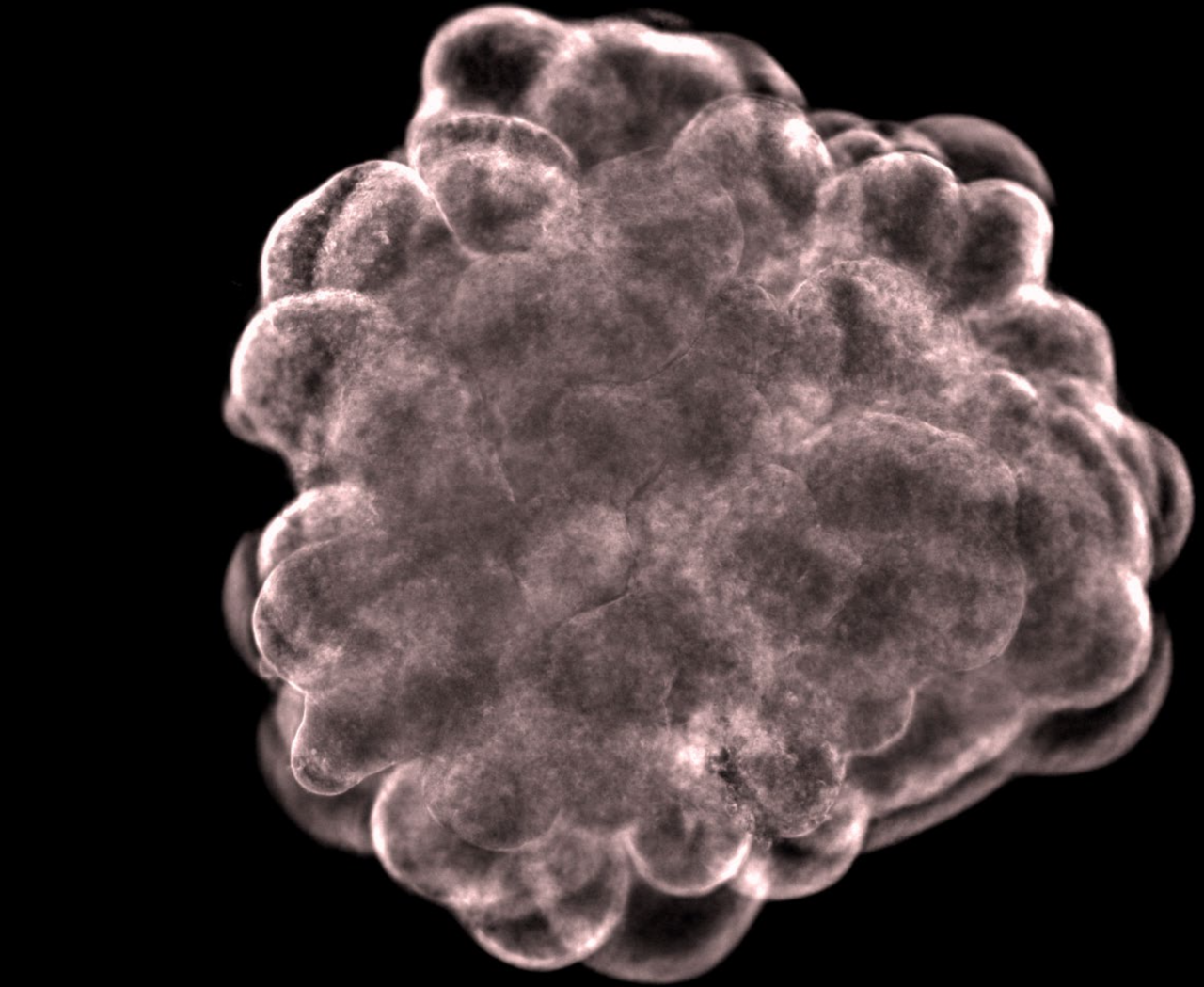
In 2020 Lucier donated his blood cells towards realising the Revivification project. With his permission, the artists transformed them into stems cells and then differentiated them into cerebral organoids. These are biological structures that have the capacity to change over time in response to stimuli and can be thought of as ‘mini brains’. Revivification features these in an immersive audio installation in which both musical ‘action’ and ‘perception’ are unified via a bioelectric system.
Conceptualised with Lucier himself, the sound environment focuses on sonic resonance and reflection, both phenomena that he explored throughout his career. The neural activity of his in-vitro ‘brain’ is extended into the space via electromechanical mallets that respond to these signals by striking large, hand-crafted brass plates.
Microphones throughout the space ‘perceive’ these tones which are then fed back to the ‘brain’ via electronic neural stimulation, a closed-loop system that allows it to constantly adapt and compose new work in the gallery space.
Revivification speculates that Lucier's creative essence may persist beyond his death. The project asks uncomfortable questions such as: what is measurable and immeasurable in the creative agency of an artist? And could their ‘surrogate performer’ uncover and express creativity of, and on their own?
Revivification was actively developed with Alvin Lucier prior to his death, and continues to be supported by his family and Estate.
By Guy Ben-Ary, Nathan Thompson, Darren Moore, Andrew Fitch and Stuart Hodgetts
Performing during Venice Music Biennale
"Music for Surrogate Performer" explores the notion of preserving a performer's legacy after their passing. what happens to a legacy once the creator has passed away? Can the essence of the original performer be retained if the person is no longer physically present?
"Music for Surrogate Performer" is a living bioengineered musical entity that utilizes neural networks to improvise live performances, serving as a proxy for the late legendary Alvin Lucier, a pioneering composer of the 20th century.
It builds upon Lucier's historical work, 'Music for Solo Performer' (1965) that explored the relationship between brainwave activity and sound generation in a temporally responsive sonic event. The piece captured the alpha waves produced by Lucier’s ‘relaxed’ brain which were then amplified and fed into a network of resonant percussive instruments. Lucier emphasised the cognitive activity of the performer as a central element to composition and challenged the traditional glorification of the performer's physical prowess by shifting the focus to their actual cognitive labour.
Music for Surrogate Performer (Commissioned by the Venice Biennale, 2023) references, celebrates and extends Lucier original piece by using cutting-edge biotechnologies and his living neural networks to expand into uncharted realms. It takes the late Lucier’s aperiodic neural activity and produces a responsive sound work that is still driven by cognitive labour – but in this case Lucier’s disembodied ‘in-vitro ‘brain’ that controls a similar setup of percussive instruments that Lucier used in the original performance in 1965.
This work, places Lucier’s Surrogate Performer in the centre of the space and suggests that through its biological agency, it will sit in for Lucier while performing his composition from 1965. It follows Lucier’s intention (as manifested in Music for Solo Performer) by further deconstructing the performer's physicality and removing them completely.
The project's significance lies in its alignment with Lucier's seminal 1965 performance, while also marking a historic word first—a deceased composer playing live after their death, facilitated through the biological agency of their ‘in-vitro brain’.
In 2018 we met Lucier and decided to collaborate and in 2020 he donated his blood to our collaborative project which we then transformed using biotechnology to become his living neural networks that we grow on specialised interfaces in a petri dish. These neural networks are Lucier’s ‘In-Vitro Brain’. While we are still developing our collaborative project with Lucier (Titled “Revivification” to be launched in January 2025), This project (Music for Surrogate Performer) follows discussions we had with Lucier before his passing away in December 2021, to use his living neural networks in an interim piece referencing his historical work from 1965 - Music for solo performer. Alvin Lucier provided his endorsement for this project during his lifetime, and it continues to be supported by his family and the Lucier estate.
Music for Surrogate Performer is a tentative approach to reconcile and build a better understanding of an impending cultural shift; a trajectory that could see our human-ness and humanity challenged on many fronts. Yesterday’s impossibilities are today’s practicalities, and it is hoped that these performances can spark the imaginations of those who witness it.
CellF is the world’s first neural synthesiser. Its “brain” is made of biological neural networks that grow in a Petri dish and controls in real time it’s “body” that is made of an array of analogue modular synthesizers that work in synergy with it and play with human musicians. It is a completely autonomous instrument that consists of a neural network that is bio-engineered from my own cells that control a custom-built synthesizer. There is no programming or computers involved, only biological matter and analogue circuits; a ‘wet-analogue’ instrument.
There is a surprising similarity in the way neural networks and analogue modular synthesizers function, in that for both, voltages are passed through components to produce data or sound. The neural interface we developed juxtaposes these two networks and in a sense creates a continuum that creates one unified network. With CellF, the musician and musical instrument become one entity to create a cybernetic musician, a rock star in a petri dish.
Premiering on October fourth, 2015, in Perth, Western Australia, CellF performed a live set with Tokyo based Australian musician Darren Moore. Sound from Darren’s drums was fed as electrical stimulations into CellF’s neural network which then responded through the modular synthesizers, its ‘body’, to create an improvised post-human sound piece. During the performance there was a clear sense of communication and responsiveness between the 2 musicians. CellF represents a radical new way to think about what a musical instrument can be and how music can be made.
cellF was inspired by an ultimately narcissistic desire to re-embody myself. However, when thinking about what kind of body I would give myself, I chose not to follow the idea of working within a humanist paradigm. I decided to portray one of my adolescent dreams – to be a rock star. The long-standing passion for music, combined with sixteen years of research exploring artistic embodiments of bio-engineered ‘brains’, laid the foundation for creating this cybernetic self-portrait.
cellF is the result of a collaborative effort involving a creative team consisting of designer and new media artist Nathan Thompson, electrical engineer and synthesiser builder Dr. Andrew Fitch, musician Dr. Darren Moore, Stem cell scientist Dr. Michael Edel, Neuro-scientist Dr. Stuart Hodgetts, and Neuro-Engineer Dr. Douglas Bakkum. A collaborative project where each member played an important role in shaping the final outcome
The development of cellF posed enormous technological challenges. Establishing unique publishable biological protocols for differentiation and electrophysiology, developing a custom made all analogue neural interface that allows interaction with the neurons through simulations, building the biological lab that is embedded into the sculptural object and contains DIY high precision tissue culture incubator and a DIY certified class 2 laminar flow biological safety cabinet to work with human genetic modified material and more…
In 2012 I was awarded a Creative Australia Fellowship from the Australia Council of the Arts that resulted in four years of research towards cellF. I had a biopsy taken from my arm and cultivated my skin cells. Using Induced Pluripotent Stem cell technology, I transformed my skin cells into stem cells. When these began to differentiate they were pushed down the neuronal lineage until they became neural stem cells, which were then fully differentiated into neural networks over a Multi-Electrode Array dish to become – “my external brain”.
These neural networks contained approximately 100,000 cells. Human brains contain approximately 100 billion neurons, interconnected via trillions of synapses. The ‘brain’ used to control cellF is essentially a symbolic one to entice the viewer to consider future possibilities that these technologies can present. But these neural networks do produce a tremendous amount of data, respond to stimuli, exhibit properties of plasticity and are subject to a lifespan.
The MEA dishes that host my external brain consist of a grid of 8×8 electrodes. These electrodes can record the electric signals that the neurons produce and at the same time send stimulations to the neurons – essentially a read-and-write interface to the “brain”.
Human musicians are invited to play with cellF in special one-off shows. The human-made music is fed to the neurons as stimulation, and the neurons respond by controlling the analogue synthesizers, and together they perform live, reflexive and improvised sound pieces or “jam sessions” that are not entirely human.
cellF sonifies the activity of the neurons in an engaging way whilst maintaining the integrity of the signals that the neural network produced. It reflects the complex nature and the spatialized aspects of the neural activity. During the performance the sound is spatialized in the space to 16 speakers. The spatialization is controlled by the neural network and reflects the spatial pockets of activity within the petri dish. Walking around the performance space offers the sensation of walking through my external brain in real time.
We plan to collaborate with other musicians and various musical ensembles and we wonder how different musical styles might influence cellF ‘s functional plasticity or ability to play. In the human brain music is known to entrain neural activity, and early music training in children alters brain structure and function. As a therapy in adults, music also enhances activity in brain circuitries after stroke or in neurodegenerative diseases such as Parkinson’s. In the long term, cellF provides a unique opportunity to understand how coherence and plasticity in neural circuits can be induced by rhythmic (and perhaps frequency) dependent inputs, with potential translational benefits.
CellF addresses my ‘interest in problematising new bio-technologies and contextualizing them within an artistic framework’. It started with a new materialist question underpinned by the belief that artistic practice can act as a vector for thought: What is the potential for artworks using biological and robotic technologies to evoke responses in regards to shifting perceptions surrounding understandings of “life” and the materiality of the human body?