Listen to »WVTADTSSPXDAMAVAND« which assails the listener with whirling dust devils of harmonic stabs, the closing track of an album that ratchets up the intensity of his relentlessly maximalist computer music, his most intense album yet, made to move the body and stimulate the brain.
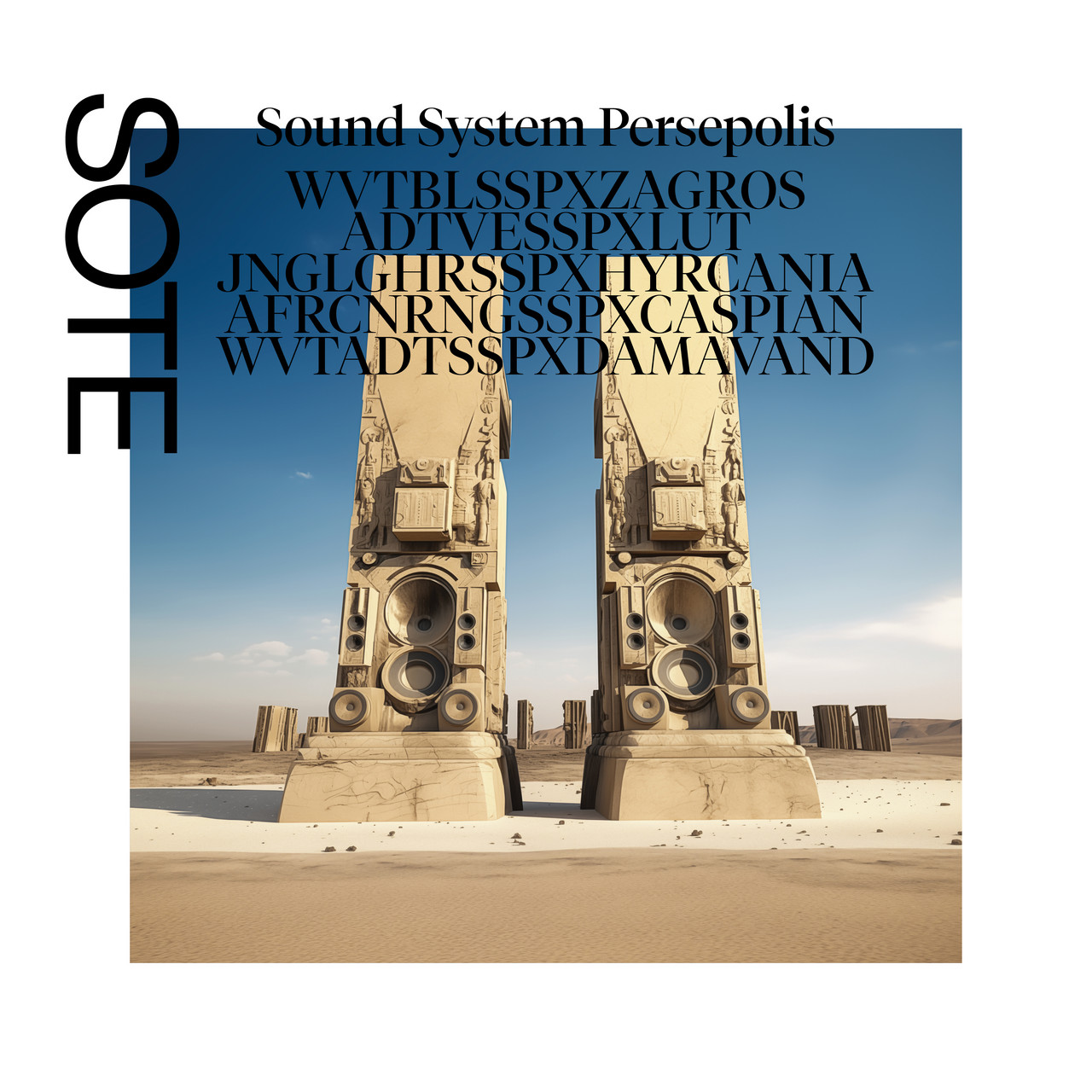
The new album – for Oscar Powell's Diagonal Records – is a futuristic hardcore album of pummellingly rhythmic and harmonically complex computer music, which takes its name from Persepolis: the beating heart and administrative centre of the historical Persian Empire. Even at low volumes the harmonics, rhythmic textures and buffeting decay conjure the sense of a monumental rig (as featured on the album artwork) playing at earth-shaking volume, capable of displacing huge volumes of air, yet with barely a kick or a snare in sight. »I think it's lazy to just be moving around hi-hats and kicks these days,« Ebtekar explains. »That's not going to be unique music. I'm interested in getting to the feeling that a kick and a snare give to you, via the possibilities of pitched and structured patterns of tones and harmonics.«
Intended to be performed live, on muscular and multi-channel soundsystems whether gallery or club, this computer music is not only meant to be heard but felt by the listener: its brutalist vibrational polyrhythms make it impossible to stand still, its directive to move standing in contrast with the more academically rooted computer music and sound art that has explored the same sound synthesis techniques used on the album. »Often sound design and sound synthesis is very serious academic music – I love a lot of that music, but Sound System Persepolis connects this back to the body,« says Ebtekar. »I want the listener to be active with their brain and I want all their organs and limbs to be moving to different rhythms.«
Sound System Persepolis [DIAG065], by Sote
Sound System Persepolis [DIAG065], by Sote
Having made music through various means over the course of his long career – including electroacoustic music rooted in Iranian instrumentation, pure noise music, and analogue synthesis - since he and his family returned to Iran ten years ago, Ebtekar has made music purely inside a computer: »My family moved to Tehran with three suitcases each, so now I just use a computer – sanctions meant I couldn't ship anything back. If you have the skills and knowledge, you can achieve any sound you want.«
The album's five track titles might, at first glance, look randomly generated, but are in fact coded references to the audio synthesis language each one uses, plus the album title and various geographical locations in Iran – the Zagros mountain range, the salt desert Lut, the Hyrcania forest, the Caspian sea, and Iran's mountain Damavand.
Opening track »WVTBLSSPXZAGROS« heralds its arrival in insistent and brutalist harmonic clangs, followed up by the hardcore sprung polyrhythms of »ADTVESSPXLUT«. »JNGLGHRSSPXHYRCANIA« sounds like a trapped flywheel, ricocheting at hyperspeed, a crescendo into absolute overload before dropping out into a more melodic motif. »AFRCNRNGSSPXCASPIAN« leans into watery basslines, its rippling textures criss-crossing like interference patterns.
With the release of Sound System Persepolis, Sote's catalogue runs to 15 albums (both under the Sote moniker and as Ata Ebtekar), plus a clutch of 12"s, remixes and a number of other projects. Of that large back catalogue, Sound System Persepolis can perhaps be best understood as a maturation of the sound found on Hardcore Sounds From Tehran (2016), as a high-velocity, high-resolution sensory overload that is at once cathartic and ecstatic: a medium for both escape and release for the body and the brain.
Sound System Persepolis is out on vinyl and digitally on 12 July 2024 via Diagonal Records – Pre-order HERE.
For world-wide bookings please message Jan Rohlf.